
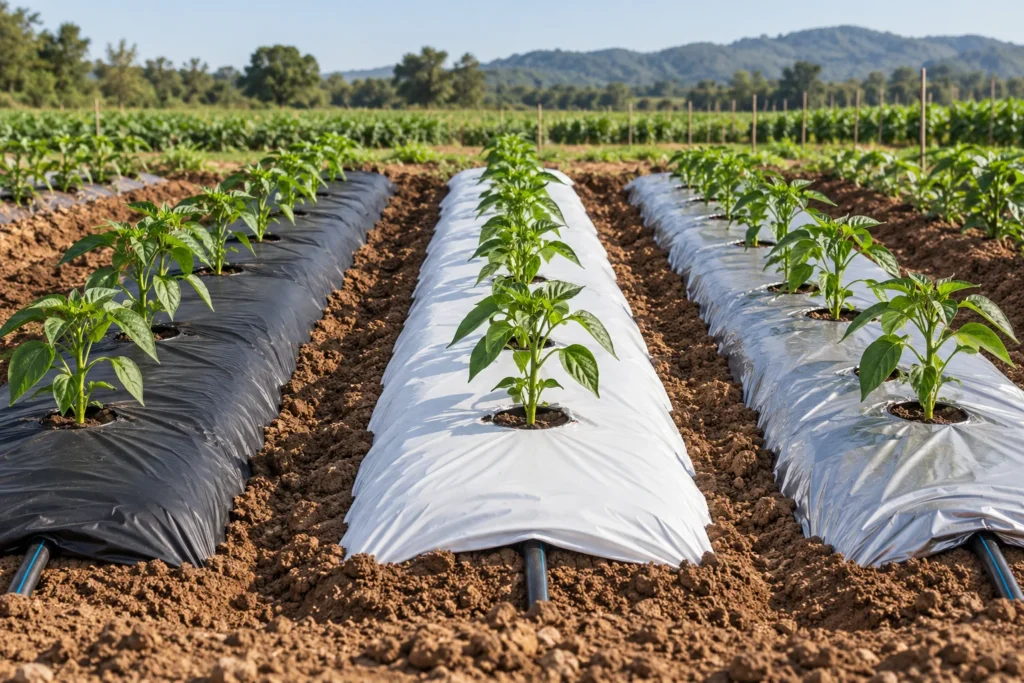
The same field, the same crop, a different film color: the root-zone conditions can change. Plastic mulch does more than cover soil. Before choosing a roll for a vegetable farm or adding it to a distributor’s range, it helps to understand what the material changes—and what it cannot solve.
This guide explains how plastic mulch works, why black, white and silver surfaces serve different purposes, and how to plan irrigation, dimensions and removal. The aim is a better field decision, rather than a longer list of product claims.
Cover image: AI-generated illustration comparing mulch colors. It does not show a ZNY Agri farm, trial or completed customer project.
Compare film colors · Calculate roll requirements · Read common questions
What is plastic mulch?
Plastic mulch is a film placed on the soil surface around a crop, usually with openings for planting. It is different from greenhouse film, which covers a structure above the crop. It also differs from woven ground cover: a solid film and a permeable textile do not handle water in the same way.
Growers use mulch to influence the growing environment near the soil surface. An opaque cover limits light reaching weeds underneath. The film can also reduce evaporation from the covered soil. However, weeds can still appear at planting holes and uncovered edges. Some persistent weeds, including nutsedge, can pierce plastic. University of Tennessee’s mulch resources explain this limitation.
Think of mulch as one component in a cropping system. Soil preparation, drainage, irrigation and weed management still need their own plan.
Black, white and silver plastic mulch: what changes?
Color affects how a surface absorbs or reflects sunlight. This can influence soil temperature and the light around the crop. A color that helps during a cool planting period may be less suitable during a hot one. The New England Vegetable Management Guide describes these differences.
| Film surface | Main reason to consider it | What to check |
|---|---|---|
| Black | Soil warming and weed suppression when the film is opaque | Root-zone heat during the growing season; good contact with soil |
| White-on-black | A reflective top surface where additional soil warming is undesirable | White side faces upward; black backing provides opacity |
| Silver-on-black | A reflective surface; potential role in managing some insect pressure | Reflective performance and local pest-management advice |
| Clear | Strong soil warming in an appropriate management system | Light transmission can allow weeds to grow underneath |
There is no universally best color. Black film needs good soil contact to transfer heat effectively. White or reflective surfaces may help avoid excess warming. Reflective mulch is not a replacement for pest monitoring or an integrated management program.
Do not turn a color comparison into a promised yield increase. Crop, season and site conditions matter. Penn State’s commercial strawberry guidance, for example, discusses reflective or white-on-black mulch for day-neutral production where keeping the soil cool is desirable. That crop-specific advice should not become a blanket recommendation for every farm.
Why irrigation must be planned before laying the film
Reduced evaporation does not mean a crop can grow without irrigation. Rain falling on a solid cover does not simply pass through it. Water availability depends on the bed layout, soil, rainfall and irrigation system.
A common approach is to position drip irrigation beneath the mulch. Check the line before covering it: confirm its location, check for leaks and verify that water reaches the intended root zone. After planting, monitor soil moisture beneath the film rather than judging conditions from the exposed path alone.
University of Minnesota Extension explains both moisture retention and the need to supply water under plastic covers. Its climate-specific examples are useful for understanding the mechanism, not for predicting results in a different country.
For a combined material plan, compare drip irrigation tape specifications with the intended bed and crop layout. Emitter spacing alone is not a complete irrigation design; flow, pressure, filtration and field conditions also matter.
Growing cucumbers vertically? Our cucumber trellis growing guide shows how to coordinate the climbing support, drip line and mulched bed.
Thickness, width and length describe different things
Thickness describes the film gauge. Width must accommodate the bed and the material required for anchoring. Length determines how far a roll can run. None of these values alone proves a film’s outdoor service life.
Keep units consistent when comparing offers: 1 millimeter equals 1,000 micrometers, while 1 mil equals 25.4 micrometers. A quotation saying “30” without a unit is incomplete. Also ask whether the quoted thickness is nominal and what tolerance applies.
The ZNY Agri product overview lists reference PE options including black film at 30 μm and silver-black film at 60 μm, with a reference roll size of 1.6 × 100 m. These are catalogue examples, not interchangeable performance grades or a recommendation for every crop. Confirm the selected construction, dimensions, tolerances and intended exposure period against the current quotation and sample.
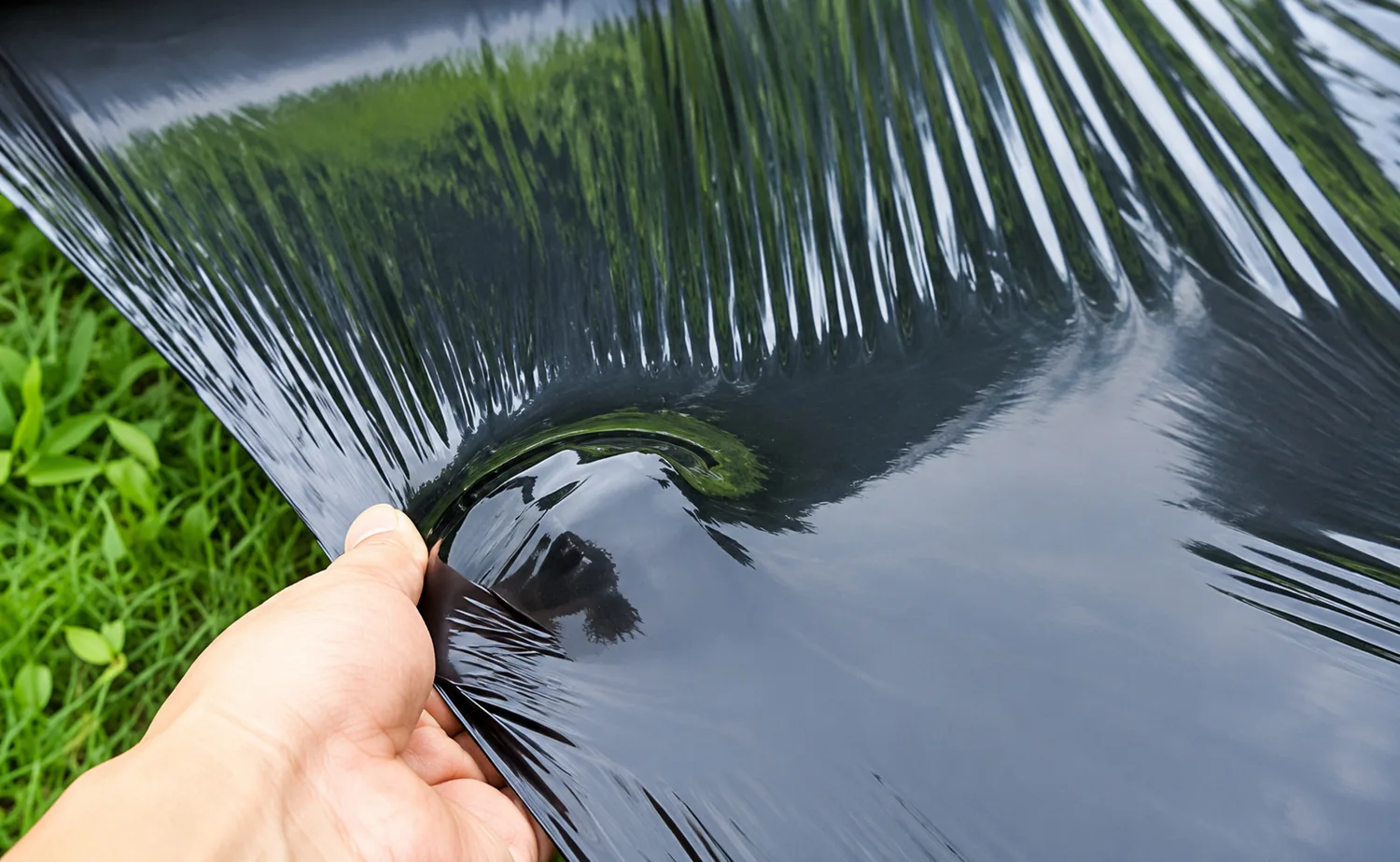
See the agricultural mulch film product page for reference options. If the application is a nursery walkway or container area, also compare weed control fabric instead of assuming every ground-cover material serves the same purpose.
A simple way to calculate roll requirements
Count bed length first, rather than dividing total farm area by roll area. Paths are not necessarily covered, and part of the film width is used on the bed sides and buried edges.
Illustrative example: 40 beds, each 90 m long, require 3,600 linear meters of film before allowances. With 100 m rolls, the arithmetic minimum is 36 rolls. However, if each bed needs one continuous piece and the 10 m remainder cannot be reused, plan for 40 rolls before adding any agreed allowance for damage or trial installation.
This is a planning example, not an installation standard. The useful calculation depends on roll length, acceptable joins, field shape and laying equipment. Send a bed layout when the quantity is uncertain; it is more informative than acreage alone.
Does biodegradable mean the film can be left in soil?
Not automatically. “Biobased” describes material origin; it does not by itself prove biodegradation in agricultural soil. Likewise, visible fragmentation does not establish complete biodegradation. Soil-biodegradable and compostable claims need evidence for the stated environment and the specific product.
The university mulch resource collection separates these terms and links to guidance on standards. Before specifying a biodegradable film, ask for the supporting documentation, intended use and disposal instructions. Conventional PE film should have a removal and appropriate waste-management plan; do not assume it is suitable for incorporation into soil.
Use a small trial to answer the questions a catalogue cannot
Before expanding across a large farm or introducing a new distributor SKU, agree on a small trial under the intended conditions. Record the product specification and laying date. Then observe installation, tearing, weed escape, soil moisture and the condition of the film through the planned season.
For a color comparison, keep the crop and management as consistent as practical. Record root-zone temperature at comparable depths and times. A local trial helps distinguish a material issue from an irrigation, installation or weather issue. It also gives the buyer more useful feedback than “good quality” or “too thin.”
Common questions about plastic mulch
Is black plastic mulch always the right choice in Africa or the Middle East?
No. A region or country name does not describe a field’s elevation, planting season, crop or soil temperature. Compare the growing conditions and the purpose of the cover before choosing a color. Local agronomic advice and a trial are more useful than a continent-wide rule.
Can mulch replace greenhouse film?
No. Mulch covers the soil surface; greenhouse film covers a structure. Specify each material for its intended position and exposure. A shared plastic appearance does not make the two applications equivalent.
Will a thicker roll always last longer?
Thickness is only one specification. Ask about the selected formulation, intended exposure, handling requirements and any documented performance claim. Compare samples and written specifications rather than using thickness as a lifetime guarantee.
For a crop-specific example, explore our watermelon growing and harvest guide. It connects mulch planning with irrigation, pollination and practical maturity checks.
Turn the science into a clear material brief
Once the application is clear, prepare six details: crop, destination and planting season, bed dimensions, preferred surface color, required roll length, and planned removal or disposal method. Add the quantity and irrigation layout if available.
ZNY Agri can discuss mulch film alongside irrigation and other vegetable-production materials. For specification questions, send a material brief or ask Ethan on WhatsApp. Availability, samples and delivery arrangements are confirmed for the actual order.