
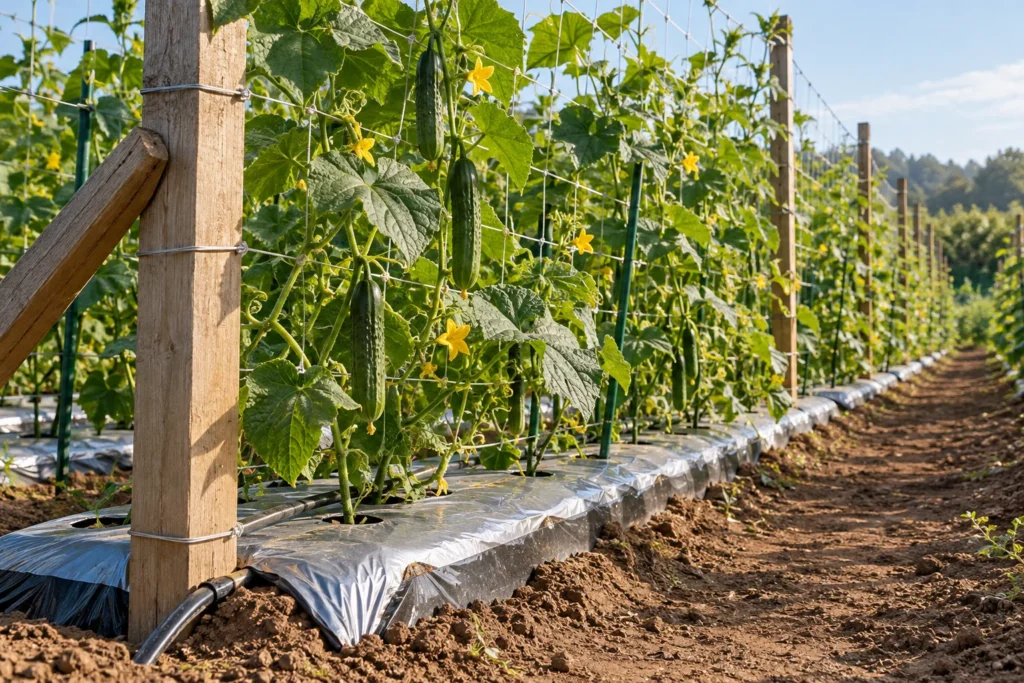
A cucumber trellis can lift the vines, but a crowded, poorly watered crop will still struggle. The useful question is not just how to make cucumbers climb. It is how to support the crop while keeping water, light, pollination and harvest access working together.
This guide explains vertical cucumber growing for growers, farm managers and agricultural suppliers. It connects the growing method with plant supports, drip irrigation and mulch selection, without treating any single material as a shortcut to better yields.
Choose a support system · Coordinate water and mulch · Check common problems · Frequently asked questions
Lead image: AI-generated cultivation illustration, not a ZNY Agri farm or customer project. It illustrates the growing system rather than a construction specification.
Why grow cucumbers vertically?
Vining cucumbers can climb a support instead of spreading across the soil. This can keep fruit cleaner and make it easier to see and reach. The University of Minnesota’s guide to vegetable supports explains that trellising vine crops can produce cleaner, straighter fruit.
There are limits. Bush cucumbers have a different growth habit, and a mechanical-harvest system has different requirements from a hand-picked crop. First decide what you will grow and how you will harvest it. Then choose the support layout.
In high tunnels, trellising can also improve space use and airflow through the planting, as described by Penn State Extension. However, the presence of a trellis does not prevent disease. A thick wall of overlapping leaves still needs attention to ventilation, crop hygiene and monitoring.
Choose a cucumber trellis system for the whole crop
Think of the installation as three connected parts: the main frame, the climbing surface and the plant connections. A rod used to guide a young plant is not automatically suitable as a structural end post.
| System | Use and checks |
|---|---|
| Upright frame with support mesh | A climbing surface along a hand-picked row. Check end bracing, anchors, mesh strength and access on both sides. |
| A-frame | A freestanding layout where the bed and aisle allow it. Check the footprint, stability, picking access and shaded areas. |
| Overhead strings | A managed protected-crop system. Confirm crop-specific training, approved overhead loads and suitable attachments. |
Post spacing, anchoring depth and working height depend on the site, mature crop, soil and wind exposure. Do not copy a small garden design directly into a long commercial row. For substantial installations, have a competent designer confirm the frame and attachments.
Support mesh and insect screen have different jobs. A climbing grid carries and guides the vines. Fine insect-exclusion mesh controls openings around a crop enclosure. Do not assume one can replace the other. Our insect netting and airflow guide explains the separate screening decision.
Where fiberglass plant support rods fit
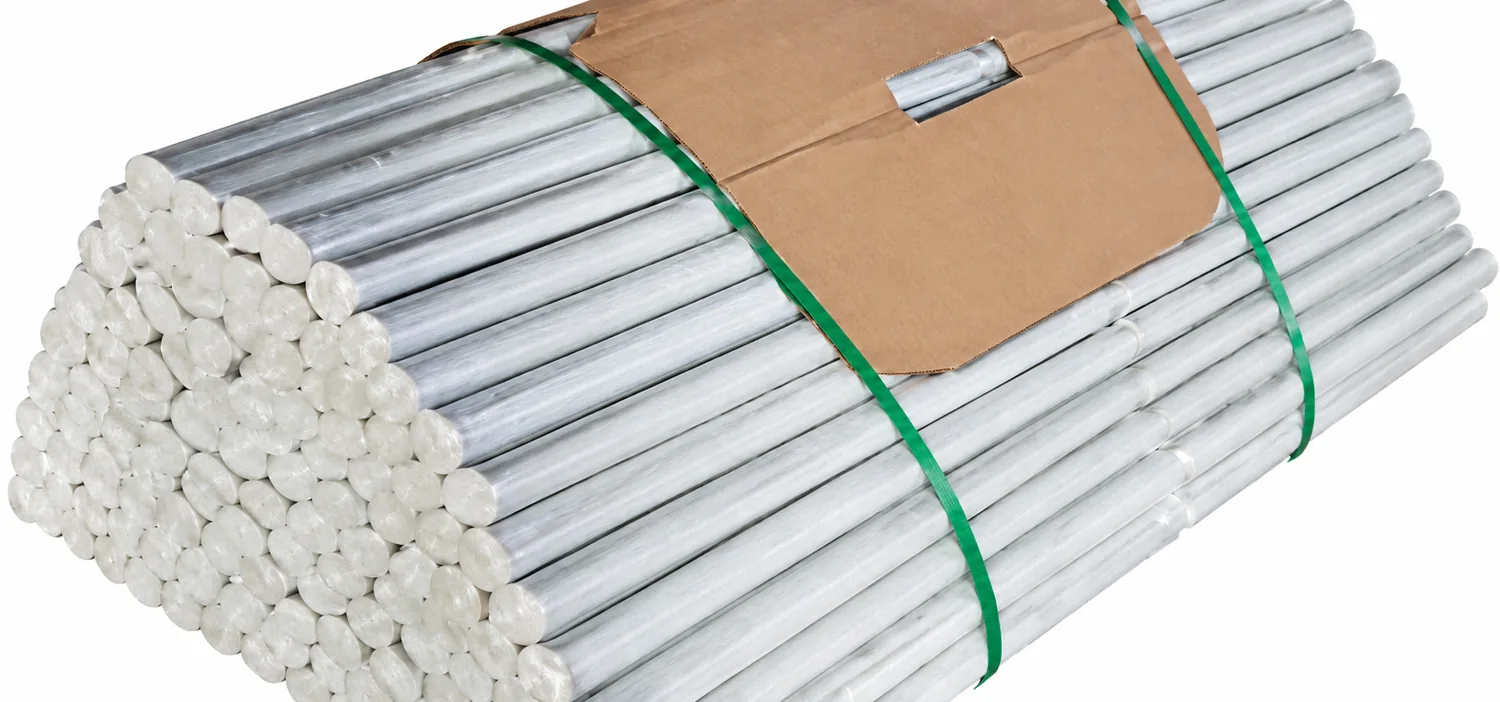
Fiberglass plant support rods are part of ZNY Agri’s crop-support range. When considering them for a cucumber layout, specify the intended role: individual plant guidance, an intermediate support or a component in a separately designed assembly.
Ask about diameter, length, surface finish, fixing method and suitability for the actual span and load. A catalogue size range is not a load rating. Check a sample and confirm performance requirements before ordering for the whole farm.
Cucumber trellis setup: install early and guide vines gently
Plan the frame, beds and irrigation together before planting. This makes it easier to place anchors without damaging an established root zone or puncturing irrigation lines later.
As vines lengthen, check them frequently and guide growing tips gently into the support openings. Minnesota Extension recommends regular guidance rather than leaving long vines unsupported. Watch for developing fruit trapped in the grid, and avoid tight ties that restrict a growing stem.
Pruning needs a separate decision. Penn State describes both mesh-supported cucumber systems with little pruning and more intensively trained systems. Follow the variety and production method you have chosen; a universal instruction to remove every side shoot can be inappropriate.
Coordinate the cucumber trellis with drip irrigation and mulch
Water the root zone, then check what actually happened
Vertical growth does not reduce the crop’s need for water. Minnesota’s cucumber growing guide notes that trellised plants may need more frequent watering. Soil texture, weather, crop size and rooting volume all affect the schedule.
Drip irrigation tape can deliver water along the planted row while avoiding routine wetting of the foliage. The result still depends on the water source, filtration, pressure, emitter selection and maintenance. Penn State’s vegetable drip-irrigation guidance stresses that benefits require a properly designed, managed and maintained system.
For a practical field check, compare root-zone moisture at the beginning, middle and end of representative rows. Also inspect for blocked emitters, leaks and unusually wet or dry patches. Adjust from measured conditions rather than using one fixed daily runtime for every country, soil and season.
Choose mulch for the growing season
Mulch can help conserve soil moisture and manage weeds around the bed. University of Georgia Extension discusses these roles in cucumber cultivation and emphasizes adequate moisture during fruiting.
Agricultural mulch film should be selected with the climate and root-zone temperature in mind. Black film can help warm soil; it is not automatically the best choice for an already hot growing season. See our plastic mulch color guide before choosing a film by appearance alone.
Coordinate bed width, planting holes and drip-line position. Keep drainage and inspection access in the plan, and arrange collection of conventional plastic film after the crop. Mulch is a management tool, not a substitute for checking the soil underneath it.
What if the vines climb but fruit production disappoints?
- Flowers but little fruit: Check the variety’s pollination requirements. Many cucumbers need insect pollination; parthenocarpic varieties can set fruit without it. “Mostly female” and “parthenocarpic” are different descriptions. Confirm the seed supplier’s instructions before enclosing the crop.
- A dense, difficult-to-pick canopy: Review spacing, training and access. Do not assume that vertical growing makes unlimited plant density possible.
- Wilting or uneven growth: Inspect moisture and irrigation delivery before adding more water. Persistent problems may also involve roots, pests or disease and need local diagnosis.
- Sagging or leaning supports: Reduce the risk of collapse by having the frame and fixings checked. Do not solve a structural problem by adding unverified rods or tightening wires without assessing the load.
For pollination background, see Minnesota Extension’s crop pollination guide and its cucumber growing guide. Neither an insect screen nor a climbing support can replace the pollination strategy required by the variety.
Cucumber trellis: frequently asked questions
How tall should the support be?
There is no single height for every cucumber crop. Match the cultivar, training method and harvest reach, while confirming the stability of the full structure. Greater height also changes the installation and maintenance requirements.
Can cucumbers climb without being tied?
Their tendrils can grip a suitable support, but young vines still benefit from regular guidance. Check that stems are not constricted and that fruit can develop without becoming trapped.
Does trellising guarantee higher yields?
No. It can improve crop access and help organize vertical growth, but variety, light, water, nutrition, pollination and plant health still determine performance. Compare a trial area under your own conditions before expanding.
Plan materials for your cucumber trellis
For farm managers and distributors, a useful purchasing brief starts with the crop rather than a roll or rod size. Include your country, open-field or protected setting, cucumber variety, bed and row dimensions, support layout, irrigation water source and approximate quantities.
ZNY Agri supplies plant support rods, drip irrigation tape and agricultural mulch film. Compare the product families and prepare a combined inquiry, or discuss your cucumber growing plan with Ethan on WhatsApp. Specifications, samples, quantities and delivery arrangements are confirmed individually.
Prepared by the ZNY Agri editorial team using the university extension resources linked throughout. Educational guidance for a global audience: adapt planting, irrigation and support design to local conditions and professional advice. Illustrations and catalogue references do not promise crop results.