A geomembrane liner may look like a roll of black plastic sheeting. In a commercial agricultural project it is not. It is an engineered barrier whose resin formulation, thickness tolerance, carbon-black content, weldability, and installation quality determine whether a reservoir holds water for twenty years or loses it from the first season.
For importers, distributors, and project buyers, the real purchase is not polyethylene by weight. It is a seepage target, a defined service life, and a documented acceptance standard. Grand View Research values the global geomembrane market at USD 1.9 billion in 2023, forecast to reach USD 2.9 billion by 2030 at a 5.4% CAGR, with HDPE accounting for 31.3% of revenue — the single largest material segment. Water management is one of the major application segments driving that growth, and agricultural storage is a significant part of it.
This guide explains what a geomembrane liner is, which specifications actually matter, why seepage costs more than most buyers expect, how thickness should be matched to an application, how it compares with the alternatives, and what has to happen on site for the liner to perform as specified.
1. What Is a Geomembrane Liner and How Does It Differ from Ordinary Plastic Sheeting?
A geomembrane is a low-permeability synthetic membrane used to control the movement of liquids or gases through a surface. In agriculture it is most often used to line water storage ponds, irrigation reservoirs, farm dams, aquaculture ponds, and manure or effluent lagoons.
The distinction from ordinary plastic sheeting is engineering, not appearance. Four differences matter:
- Resin formulation. A geomembrane is produced from a defined resin grade, typically around 97.5% virgin polyethylene with roughly 2.5% carbon black plus antioxidants and stabilisers. General-purpose sheeting is often made from recycled or unspecified resin with no controlled additive package.
- Thickness tolerance. Geomembranes are manufactured to a stated nominal thickness with a controlled tolerance. Utility sheeting is frequently sold at a nominal figure that is not met across the roll.
- Weldability. Geomembranes are designed to be joined into a continuous, testable barrier by thermal welding. Sheeting is usually joined by tape or adhesive, which is not a verifiable seam.
- Traceability. A geomembrane roll carries batch identification so that test records can be matched to the material actually installed. Sheeting typically does not.
The carbon black figure is not a marketing detail. It is the material’s primary defence against sunlight. A liner compounded below the reference level will chalk, crack, and lose tensile strength in an exposed application — and the failure will appear two or three seasons in, long after the container has been paid for.
Which material should an agricultural buyer choose?
Four polymer families dominate, and each has a different trade-off:
| Material | Typical strength | UV / weathering | Flexibility | Best fit |
|---|---|---|---|---|
| HDPE (high-density polyethylene) | Highest tensile and tear resistance of the common grades | Excellent when carbon black is properly compounded | Low — stiff, needs good subgrade | Large reservoirs, long service life, exposed or covered |
| LLDPE / LDPE | Good elongation, lower tensile than HDPE | Good | High — conforms to irregular ground | Small and medium farm ponds, uneven subgrade |
| PVC | Moderate | Moderate — plasticiser migration over time | Very high | Complex shapes, temporary or decorative ponds |
| EPDM | Moderate, excellent elasticity | Very good | Very high | Small ponds, cold climates; highest cost per m² |
For agricultural water storage at commercial scale, HDPE is the default choice because it offers the best balance of mechanical strength, chemical resistance, and cost per square metre. That is also why it holds the largest share of the global market.
2. Which Geomembrane Specifications Actually Matter to Agricultural Buyers?
Buyers who compare quotations on thickness and price alone are comparing the two least informative numbers. A 1.0 mm liner made from recycled resin with insufficient carbon black will fail faster than a well-compounded 0.75 mm liner on a properly prepared subgrade.
The properties worth specifying in writing are these:
| Property | What it controls | Why a buyer should care |
|---|---|---|
| Nominal thickness | Puncture and tensile reserve | Sets the liner’s tolerance to subgrade irregularities and installation damage |
| Density | Resin quality and crystallinity | Low density can indicate recycled content or off-grade resin |
| Carbon black content | UV resistance | Around 2.5% is the industry reference; below this, exposed liner degrades |
| Tensile yield and break strength | Load capacity at the seam and in the field | Commonly tested to ASTM D6693; the figure should match the grade offered |
| Tear resistance | Resistance to propagation of a nick | A small installation cut should not become a full-length split |
| Environmental stress crack resistance (ESCR) | Long-term cracking under stress and detergent contact | Directly linked to service life in buried and chemical-exposed applications |
| Dimensional stability | Shrinkage after installation | Poor stability causes the liner to pull away from anchorages |
| Seam peel and shear strength | Whether the joins hold | Seams are the most common failure point in the entire system |
The widely referenced specification for HDPE geomembranes is GRI GM-13, which sets minimum values for these properties and is commonly cross-referenced with ASTM test methods. If a supplier cannot state which standard the material is tested against, the quotation is not comparable to one that can.
3. Why Does Seepage Matter More Than Most Buyers Expect?
This is the part of the decision that is usually underestimated. Seepage loss is not a fixed percentage of storage — it is a volume per square metre per day, which means it scales with the surface area of the pond and compounds across the whole year.
Consider a 10,000 m² reservoir. An unlined or poorly lined subgrade in silty or sandy soil can lose water at several millimetres per day. At 3 mm/day, the loss is 30 m³ every day — roughly 11,000 m³ per year. At a pumping cost of USD 0.50 per m³, that is USD 5,500 of water and energy per year, before any consideration of crop loss during a dry spell.
A liner at 0.75 mm that reduces loss to near zero pays for itself on that arithmetic alone. Three further costs are usually left out of the calculation:
- Pumping and energy. Every cubic metre that leaks has already been paid for once in fuel or electricity.
- Storage capacity. A leaking reservoir effectively shrinks. In a dry season, the shortfall appears at exactly the moment water is most valuable.
- Water quality and contamination. Seepage runs in both directions. A liner also prevents saline groundwater, agricultural chemicals, or effluent from migrating into the stored water or into surrounding soil.
In regions where water is the binding constraint — across much of Africa, the Middle East, and South Asia — this is not an efficiency argument. It is the difference between having a reservoir and having a hole in the ground.
4. How Do You Match Liner Thickness to the Application?
Thickness is a function of three variables: the value and volume of what is being stored, the condition of the subgrade, and the exposure the liner will face. The reference configurations below are starting points for discussion, not a stock list — final grade, tolerances, and performance are confirmed per order.
| Thickness | Typical application | Subgrade requirement | Notes |
|---|---|---|---|
| 0.50 mm | Small farm ponds, short-cycle storage, decorative water features | Fine, well-compacted, stone-free | Lowest cost per m²; limited puncture reserve. Not recommended where livestock or machinery will enter |
| 0.75 mm | General irrigation storage, farm dams, medium ponds | Compacted, cleared of sharp material | The practical default for most agricultural storage; best balance of cost and durability |
| 1.00 mm and above | Aquaculture, large reservoirs, harsh or rocky subgrade, exposed sites | Compacted, with geotextile protection where needed | Higher puncture and tensile reserve; required where the liner is exposed to UV and mechanical load |
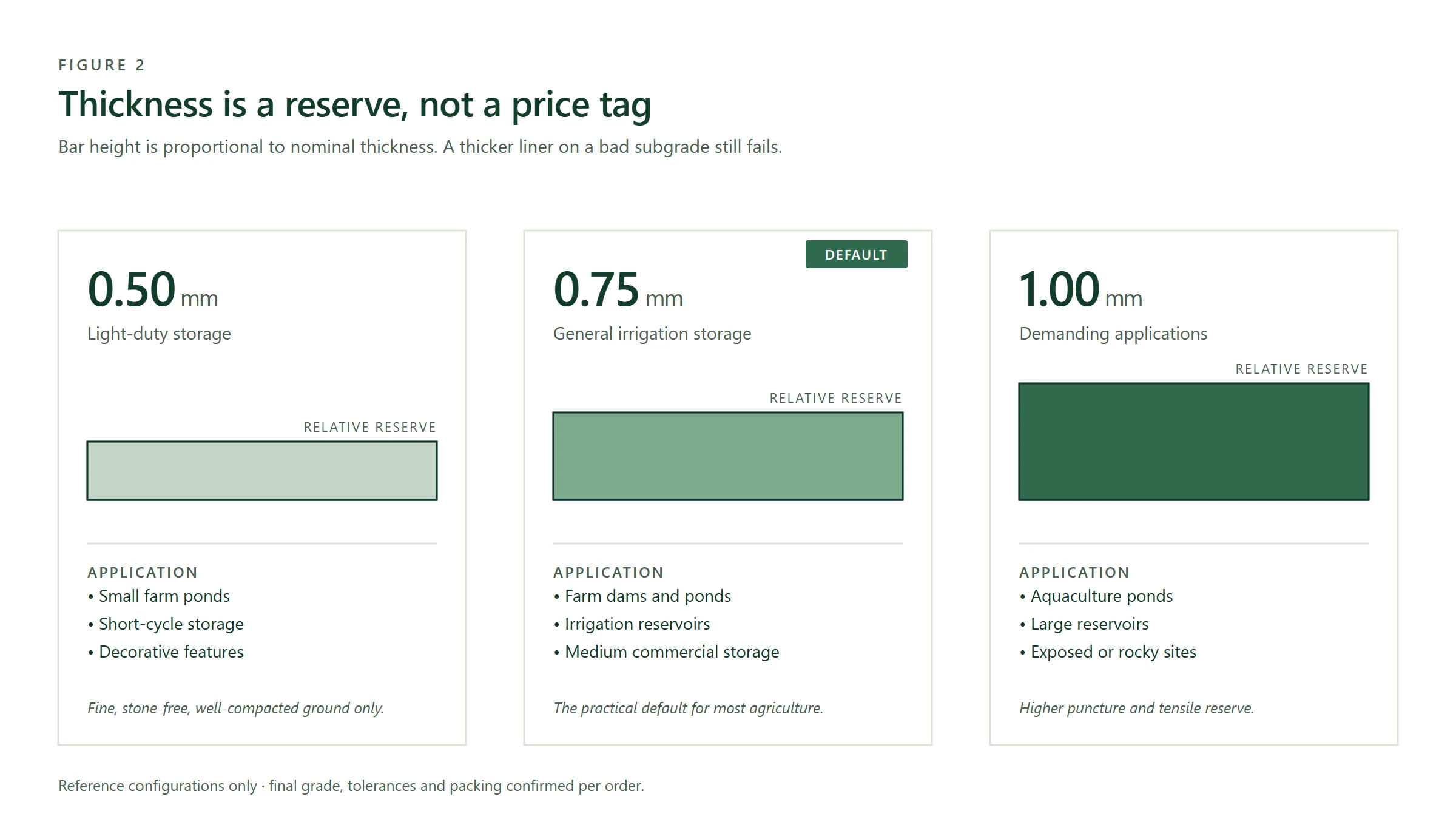
Two rules of thumb are worth carrying into a specification discussion. First, thickness cannot compensate for a bad subgrade — a 1.5 mm liner laid on uncompacted ground with sharp stones will fail sooner than a 0.75 mm liner on properly prepared ground. Second, exposed liner needs more than buried liner, because UV exposure and thermal cycling are additive to mechanical stress.
5. How Does a Geomembrane Compare with Clay, Concrete, and GCL?
Buyers rarely choose between “liner” and “no liner”. They choose between lining methods, and each has a different failure profile and cost structure:
| Method | Permeability | Flexibility / crack tolerance | Installation speed | Typical constraint |
|---|---|---|---|---|
| HDPE geomembrane | Very low | Moderate — resists movement but not puncture | Fast; rolls can be deployed at scale | Depends entirely on welding quality |
| Compacted clay | Moderate — still permeable at a measurable rate | Poor — cracks on drying and shrinkage | Slow; requires suitable clay source and heavy compaction | Clay availability and volume of earthmoving |
| Concrete | Low when intact | Very poor — cracks under settlement and thermal movement | Slow; needs formwork, curing, joints | Cost and joint maintenance; cracks are hard to trace |
| GCL (geosynthetic clay liner) | Low, self-sealing where hydrated | Good | Fast | Requires confinement and sustained moisture; poor in high-ionic or drying conditions |
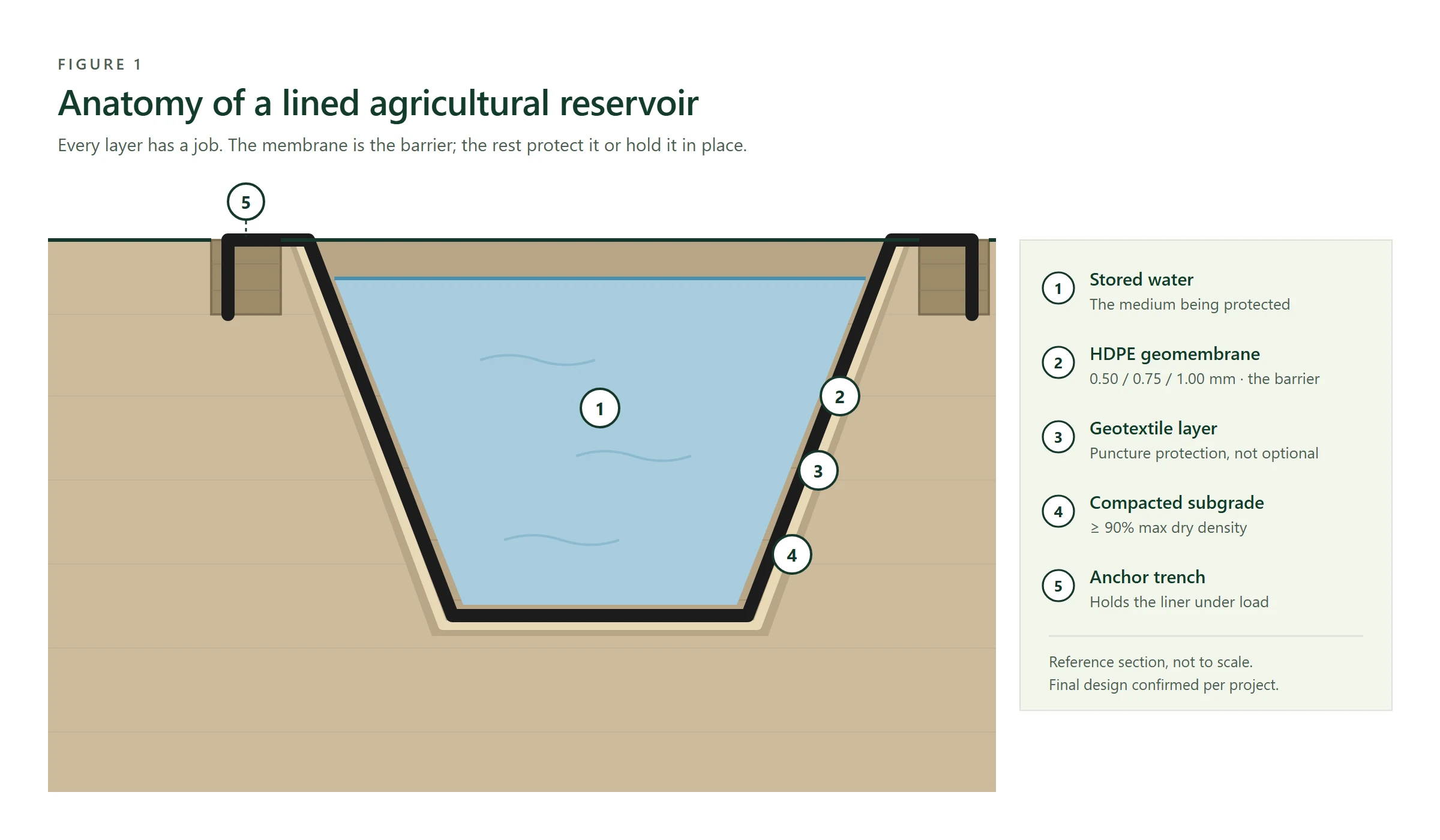
In practice, the strongest agricultural specification is often composite: a geomembrane for the primary barrier, with a geotextile for puncture protection, and in some designs a clay or GCL layer beneath as a secondary defence. The geomembrane is the component that actually delivers near-zero permeability; the other layers protect it and provide redundancy.
Concrete is sometimes chosen for small structures on the grounds that it “looks permanent”. For reservoirs of any size, the joint and crack maintenance burden usually outweighs the perceived durability advantage — and a crack in concrete is considerably harder to find than a failed seam in a tested liner.
6. What Does Correct Installation Require?
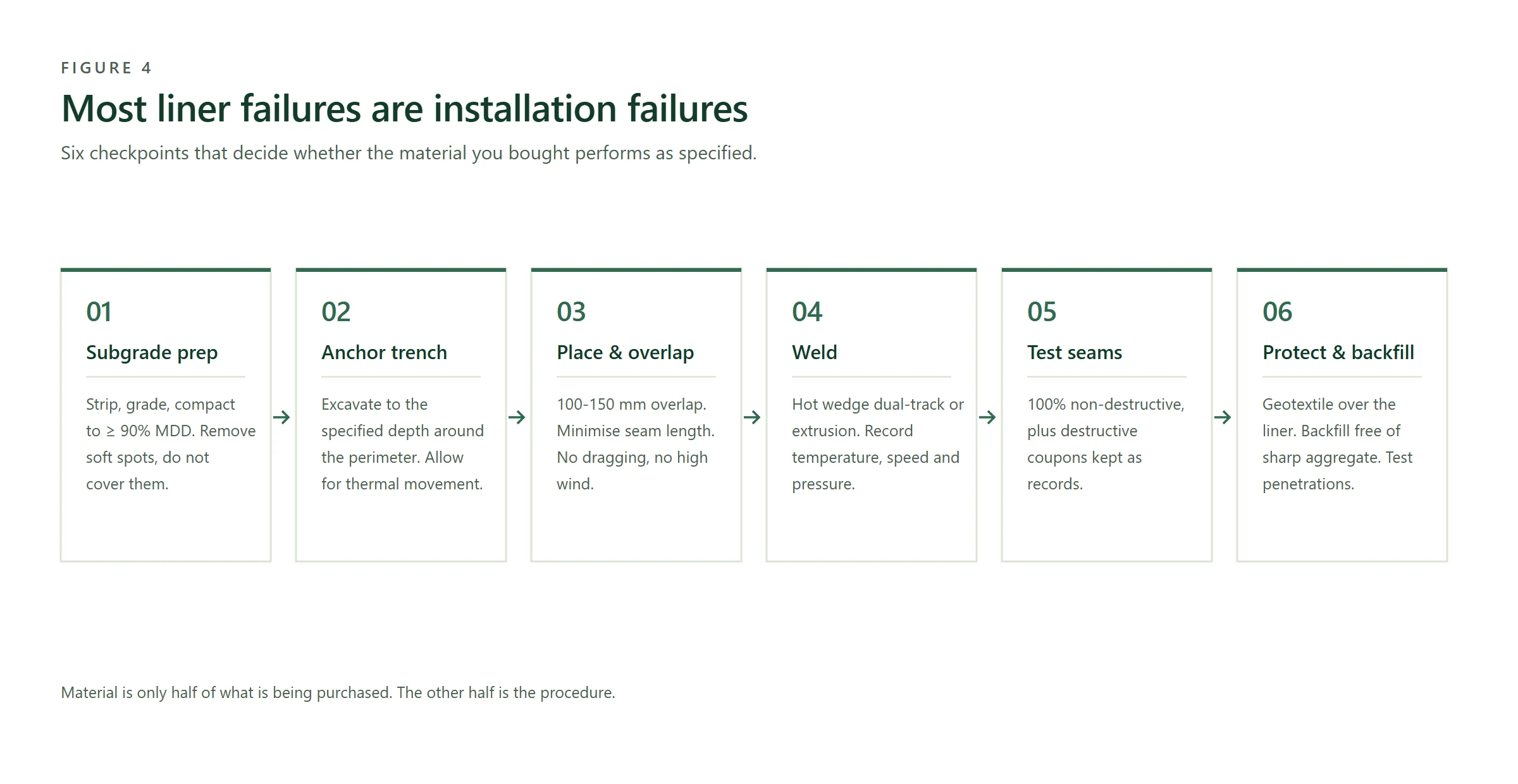
Most liner failures are not material failures. They are installation failures. This is the section a buyer should read before signing an offer, because the material is only half of what is being purchased.
Subgrade preparation
The ground must be stripped of vegetation and sharp objects, graded to a smooth profile, and compacted — typically to at least 90% of the specified maximum dry density. Any soft spot must be removed, not covered. Anchor trenches must be excavated around the perimeter to the specified depth and width.
Placement and overlap
Panels are laid with controlled overlap, commonly in the 100–150 mm range, and positioned to minimise seam length and stress at corners. Panels should not be dragged across prepared ground, and should not be installed in high wind.
Welding
Two methods are standard. Thermal fusion (hot wedge or hot air) produces a dual-track seam that leaves an enclosed channel for non-destructive air pressure testing. Extrusion welding is used for patching, detail work, and pipe penetrations. Welding temperature, speed, and pressure must be recorded and held constant, and trial welds should be made and tested before production welding begins.
Seam testing
This is where documentation separates a professional installation from an optimistic one:
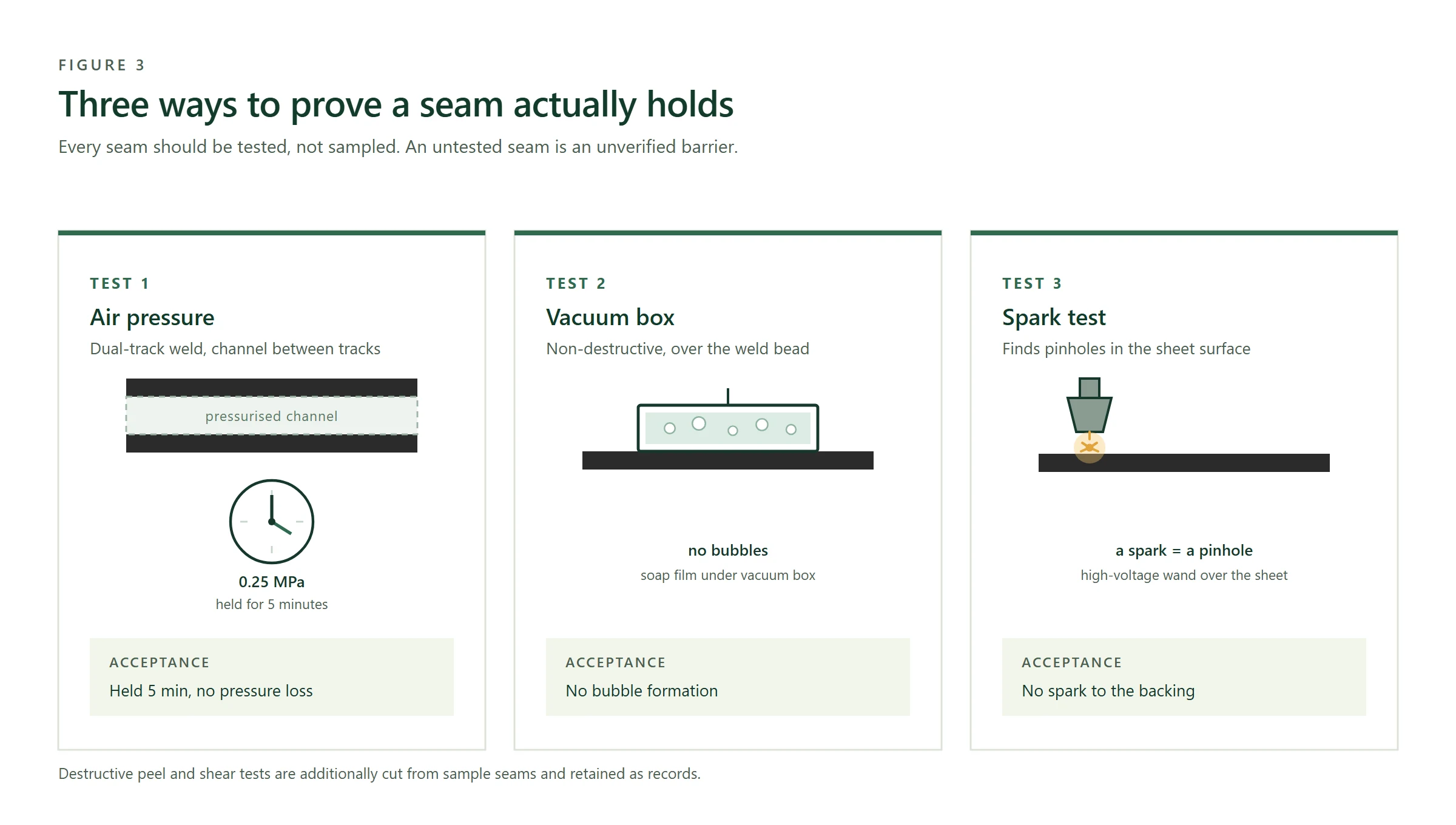
| Test | Method | Acceptance |
|---|---|---|
| Air pressure (dual-track seam) | Pressurise the channel between the two weld tracks | Commonly held at around 0.25 MPa for 5 minutes with no pressure loss |
| Vacuum box | Soap solution over the seam under a transparent box | No bubble formation |
| Spark / holiday test | High-voltage wand across the surface | No spark to the conductive backing — finds pinholes |
| Destructive test | Cut coupons from sample seams and test peel and shear | Values meet the specified minimum; coupons are retained as records |
Every seam should be tested, not sampled. Non-destructive testing is fast, and an untested seam is an unverified barrier.
Protection and backfill
Where the liner will be buried or walked on, a geotextile protection layer is placed above it before backfill. Backfill and cover material must be free of sharp aggregate. Around pipe penetrations and outlet structures, boots and collars should be extrusion-welded and tested separately.
7. How Should Buyers Verify Quality Before the Container Ships?
Quality is confirmed in writing before production, not inspected into existence at the port. A buyer sourcing from overseas should secure the following:
- Resin statement. Virgin resin content, carbon black percentage, and the additive package — in the offer, not in conversation.
- Batch-linked test reports. Tensile, density, carbon black content, tear, and ESCR results that correspond to the actual production batch, not a generic certificate from a previous year.
- Standard reference. The specification the material is tested against, such as GRI GM-13 or the applicable national standard.
- Roll identification. Each roll marked with batch number, thickness, dimensions, and net weight so installed material can be traced back to records.
- Dimensional verification. Measured width, length, and thickness on a sample of rolls, with the tolerance stated.
- Packing specification. Roll core, wrapping, and loading plan — relevant because a long sea route with poor packing produces handling damage that shows up as leaks.
- Third-party inspection. Where the order value justifies it, an independent pre-shipment inspection is cheaper than discovering a shortfall on site.
A supplier who can produce these items promptly is describing a controlled process. A supplier who deflects them is describing a trading arrangement.
8. How Is Liner Quantity Calculated and What Should a Buyer Budget For?
Liner is quoted per square metre, but the quantity purchased is never the flat area of the pond. Four allowances have to be added, and omitting them is the most common cause of a short order that cannot be completed on site:
- Slope area. The sides of the pond are part of the surface. A pond 2 m deep with sloped walls has substantially more lined area than its water surface suggests.
- Overlap for welding. Panels are overlapped before welding, so the same square metre is effectively consumed twice at every joint. A 100–150 mm overlap on many seams adds up quickly.
- Anchor trench allowance. Liner must extend into the perimeter trench, typically 0.5–1.0 m of additional material all the way around.
- Waste and cutting. Irregular shapes, corners, and penetrations generate offcuts that cannot be used. A working allowance of 5–10% is normal.
A practical formula for the order quantity is: (base area + slope area) × (1 + overlap factor) + anchor trench allowance + 5–10% waste. A supplier quoting purely on the flat area of the pond is either misunderstanding the project or planning to have the buyer discover the shortfall later.
On budget, the material cost per square metre is only the first line. Freight is driven by volume rather than weight, and liner is bulky — which is why panel width and roll configuration affect the landed cost as much as the price per m² does. Installation, welding, testing, and any geotextile layer are separate again. A buyer comparing two quotations should compare the landed and installed cost, not the ex-works price.
9. What Drives Failure — and How Do You Prevent It?
Across agricultural liner projects, failures cluster into a small number of causes. Each has a known countermeasure:
| Failure mode | Root cause | Prevention |
|---|---|---|
| Seam separation | Wrong weld temperature or speed; contaminated seam surfaces; untested joins | Trial welds, recorded parameters, 100% non-destructive testing, destructive coupons |
| Puncture | Sharp stones, roots, or debris left in the subgrade; machinery traffic | Subgrade clearing and compaction, geotextile layer, controlled site access |
| UV degradation | Insufficient carbon black; long-term exposure without cover | Specify carbon black content, cover exposed areas, or select a grade rated for exposure |
| Stress cracking | Low ESCR resin under sustained load; poor anchorage causing point stress | Specify ESCR, design anchorage correctly, avoid over-tensioning during installation |
| Pull-out at anchorage | Anchor trench too shallow or backfill not compacted | Correct trench dimensions, compacted backfill, allowance for thermal movement |
| Chemical attack | Liner grade incompatible with stored effluent or chemicals | Disclose the stored medium before ordering; confirm chemical resistance in writing |
Frequently Asked Questions
What thickness of geomembrane liner do I need for a farm pond?
For most agricultural irrigation storage, 0.75 mm HDPE is the practical default. Move to 1.0 mm or above for aquaculture, large reservoirs, exposed sites, or subgrade that contains material difficult to fully clear. Go to 0.5 mm only for small, short-cycle ponds on fine, well-compacted ground.
How long does an HDPE geomembrane liner last?
Service life depends far more on exposure and installation than on the material alone. A covered liner on a well-prepared subgrade is generally expected to perform for decades; an exposed liner in high-UV, high-thermal-cycling conditions has a shorter working life. This is why carbon black content and cover design belong in the specification.
Can the liner be joined on site, or must it arrive as one piece?
Site welding is standard practice and is normally preferred, because factory panels large enough to cover a reservoir would be impractical to transport. The quality of the finished barrier depends on the welding and testing procedure, which is why seam testing records should be part of the handover documentation.
Do I need a geotextile under the liner?
Not always, but frequently. A geotextile is recommended where the subgrade contains aggregate that cannot be fully removed, where the liner will be subject to mechanical loading, or where groundwater pressure exists beneath the liner. It is inexpensive relative to the cost of repairing a punctured liner.
Can a geomembrane liner be repaired?
Yes. Small damage is repaired with a patch extrusion-welded over the affected area, and the repair is then tested by spark or vacuum box. This is one reason traceability matters: knowing the exact material grade allows a compatible patch to be used.
Is a black liner going to heat the stored water too much?
Surface temperature does rise, and in shallow ponds this can encourage algae. The usual responses are to increase depth, to cover the reservoir with a shade net, or to specify a lighter-coloured or reflective surface where available. In deeper storage the effect is limited to the top layer.
What information should I send to get an accurate quotation?
Pond dimensions and profile, intended use and stored medium, subgrade condition, whether the liner will be exposed or covered, required thickness or standard, destination port, and required delivery date. With those seven items, a supplier can quote a specification rather than a guess.
Start with the storage requirement, not the roll size
A liner specification only makes sense against a specific pond, a specific stored medium, and a specific subgrade. Send the dimensions, the intended use, and the destination, and we can work from your requirement rather than from a catalogue number.
ZNY Agri supplies HDPE geomembrane liner in 0.50 / 0.75 / 1.00 mm reference configurations, with grade, dimensions, and packing confirmed per order. Production and export coordination sit in one team, and our Kenya branch and overseas warehouse support regional enquiries across East Africa.
View geomembrane liner reference specifications · Agricultural water storage solutions · Manufacturing and quality control · Request a quote
Reference configurations are not a stock list. Final grade, tolerances, net and gross weight, packing, and performance are confirmed for each order. Shade netting is frequently specified over open reservoirs to limit algae growth and evaporation; see our shade net range for compatible specifications, and our drip irrigation tape range where stored water is delivered to the root zone.