
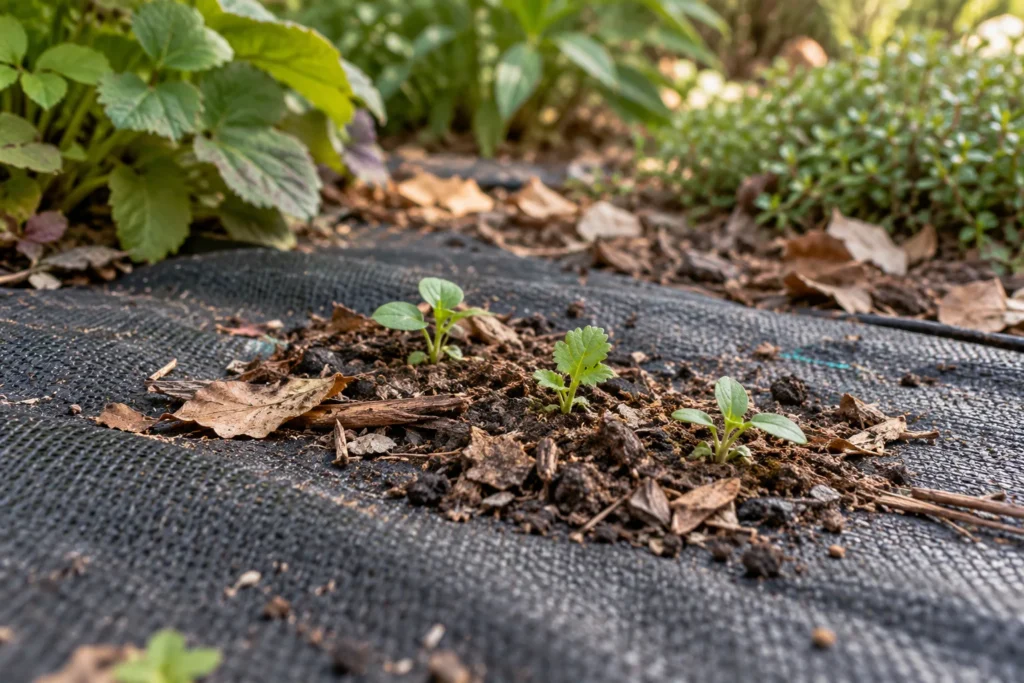
A weed above landscape fabric is not always growing through it. It may have started in a thin layer of soil, broken-down mulch or leaf debris resting on the surface. That distinction explains why a covered bed can look weedy even when much of the material underneath remains intact.
To understand the result, look at three things together: the origin of the plant, the continuity of the cover and the conditions above and below it. This guide explains the biology behind those observations and offers a practical way to investigate a covered planting bed.
Three weed pathways · Water and roots · The role of the site · Observation checklist
Lead image: AI-generated gardening illustration, not a photograph of a product test, company property or customer project. It illustrates a possible situation and does not diagnose a real installation.
What landscape fabric changes at the soil surface
Landscape fabric is a ground-cover textile used as a physical barrier. Woven and nonwoven constructions differ, and the material is not the same as an unbroken sheet of plastic. Utah State University’s mulch guidance describes fabric as an inorganic covering that can allow water and air movement.
Its role is to change the conditions encountered by vegetation at the surface. It does not remove all seeds from the soil, replace the soil itself or identify which weeds are present. A successful cover can therefore reduce one route to establishment without closing every route into the bed.
Treat the covered bed as a layered system. The soil underneath, the textile, any mulch on top and the surrounding planting all contribute to what happens next.
Weed biology explains why a barrier has limits
Light stimulates germination in many weed species, but “blocking light” is not the same as destroying the weed seed bank. Maryland Extension’s nonchemical weed-management guide explains that viable seeds can remain dormant in soil for years and respond when conditions become suitable.
Annual weeds complete their life cycle within a year or less. Perennial weeds can persist through living roots, rhizomes, tubers or other structures as well as seeds. Removing a shoot does not necessarily remove the part capable of regrowth.
That is why a new flush of small seedlings and the return of an established creeping weed should not automatically receive the same diagnosis. Identify the plant and its growth habit before deciding what failed.
Three ways weeds appear around landscape fabric
1. Germination in material above the cover
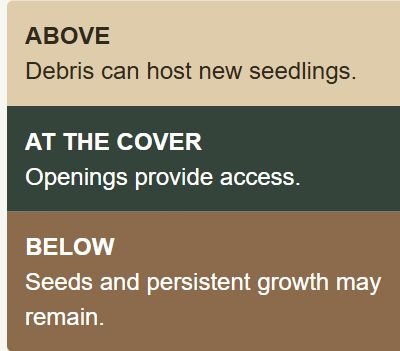
The upper surface can acquire a growing layer of its own. Maryland notes that weeds can germinate in accumulated soil or organic matter above fabric and later send roots down through it. A seedling rooted initially in that upper layer is a different situation from a shoot pushing upward from the original soil.
2. Growth at an opening, edge or seam
The University of California’s landscape weed-management guidance emphasizes continuity: gaps and planting openings provide places for weeds to emerge. Soil left on top after planting can also introduce seeds above the barrier.
3. Growth from persistent vegetation underneath
Some established perennial weeds have substantial underground reserves. UC IPM identifies nutsedges and field bindweed among weeds that can defeat physical mulch barriers. A surface covering should not be treated as proof that all vegetation beneath it has died.
Water passing through is only part of the story
A textile described as permeable does not, by itself, establish whether plant roots are receiving suitable moisture. Look at the condition of the installed layers, the soil and the irrigation pattern, rather than relying only on the appearance of the upper surface.
The University of Florida’s landscape weed-control guidance explains that irrigation placement affects weed opportunities. Watering bare spaces across an entire bed can favor weeds there, while localized irrigation directs water closer to the desired plants.
For an observation, compare a point near the water outlet with one between outlets. Inspect below the cover as well as above it. Record the timing of rain and irrigation, because a single dry or wet surface photograph is an incomplete description of root-zone conditions.
Fabric, organic mulch and soil amendment are different
Mulch means material placed over the soil surface. It is not necessarily material incorporated into soil. Minnesota Extension’s mulching guide distinguishes plant-derived materials, which decompose and add organic matter, from inorganic covers such as fabric, stone and plastic.
A synthetic cover therefore does not perform the same biological role as decomposing wood chips or leaves. Choose the purpose first: physical separation, weed suppression, soil protection or addition of organic matter. One visible layer does not automatically deliver every function.
For a related explanation of soil-covering materials, see our guide to plastic mulch and film colour. Understanding the material’s position and purpose is more useful than treating all covers as interchangeable.
The same landscape fabric can create different maintenance problems
A stable gravel surface and a frequently replanted bed ask different things of a textile. UC IPM describes fabric as a separating layer beneath rock mulch, but cautions against uses where repeated replanting or the desired spread and rooting of groundcovers conflict with the barrier.
In planted beds, roots can become entangled with the material. Florida’s guidance warns that this can complicate removal and potentially damage ornamentals rooted into it. An old covered bed needs inspection before someone assumes the material can simply be lifted away.
Cornell’s guidance on managing weeds after planting also highlights debris accumulation and difficult weed removal where roots enter fabric. This explains why an initially tidy surface can require a different maintenance approach as the planting ages.
An observation checklist before changing the cover
- Describe the pattern. Mark whether weeds are scattered over the surface or concentrated along a seam, opening or bed edge.
- Identify one representative plant. Record its appearance and growth habit. Use a local identification service when the species is uncertain.
- Locate the origin carefully. At a small accessible point, distinguish loose roots in upper debris from growth connected to the soil below. Avoid disturbing the roots of the intended plants.
- Record the layers. Note surface litter, added soil, mulch, visible damage and previous repairs. Do not label every seedling a fabric puncture.
- Check the water pattern. Compare surface observations with moisture beneath the cover and the recent watering history.
- Document follow-up. Revisit the same marked area. A sequence of dated observations is more informative than one photograph after a dramatic intervention.
Does replacing landscape fabric solve every weed problem?
No. If seedlings are establishing in material accumulating above the cover, replacement alone leaves that source of future establishment unexplained. If the problem is an opening or persistent underground growth, those observations point to different questions.
The aim is to understand the weed pathway and manage the whole planting system. A cover can be one useful element, but continued observation, appropriate surface management and knowledge of the plants remain essential.
Educational article prepared by the ZNY Agri editorial team using the university extension resources linked throughout. Adapt observations and management to local species, soil and planting conditions. The lead image is an AI illustration; the layer diagram is conceptual.